

What is the FNET Human Rights Due Diligence Reporting Tool?
The FNET human rights due diligence (HRDD) Reporting tool was developed to enable businesses of all sizes to assess their maturity and identify key actions to prioritise in their human rights approach. It allows users to assess their maturity in key areas including policy, traceability, risk assessment and remedy, which map to best practices in the UN Guiding Principles, and develop clear action plans.
Marks & Spencer invested in improvements in 2025, adding environmental and human rights impacts and updating the format for ease of use, and this updated version is now used by FNET members.
The framework has also been adopted by the IGD for incorporation into their sustainability tool. Retailers such as Marks & Spencer and Ocado use this with their suppliers. This means that suppliers who complete the template once can use it with multiple customers, which reduces duplication.
FNET members have used this framework in a variety of ways:
- To build understanding of how to implement international good practice
- To assess their own human rights due diligence progress and areas to prioritise
- To support their suppliers to do the same
- To report to their customers, such as Marks & Spencer and Ocado
- To build an internal business case for investment in human rights activity plans
- To track maturity over time, identify gaps and good practice
How FNET Members Use the Human Rights Due Diligence Framework
Case studies: Marks and Spencer
M&S Food were the first business to develop and use the tool. M&S Food’s recent investment in the updated, aligned FNET version and incorporation of environmental human rights impacts have made it very popular with FNET members, as the tool makes self-assessment simple. By using the same tool with their supply chain, they are reducing the burden on suppliers who are already FNET members.
“M&S Food launched the Human Rights Due Diligence review programme in 2021 to maintain the highest ethical standards for sourcing. We’re always looking at ways to raise those standards ahead of legislation change, and so we worked closely with FNET and our supplier partners to develop and update this tool to drive mature approaches to human rights due diligence.”
Deborah Johnson, Human Rights Lead at Marks & Spencer
Case studies: Fullers Foods
Gabriella Partner, Responsible Sourcing Coordinator at Fullers Foods, trialled the tool with suppliers in 2025-6. Gabriella says,
“Like many businesses, we traditionally relied heavily on audits. They remain important, they set a baseline. But over time it became clear that audits alone don’t always capture the full picture. One of the biggest shifts for me personally has been recognising that effective due diligence is less about collecting more information and more about asking better questions.”
Gabriella Partner
That realisation prompted Fullers to explore how HRDD could help them move from reactive compliance toward proactive risk prevention and capability building. They chose the FNET HRDD tool to use with suppliers because it helps identify where support and intervention can make a difference and supports suppliers to generate clear 12-month action plans.
For Fullers, the pilot has been a success, and they are now scaling the approach across their strategic supplier base and embedding HRDD more firmly within supplier management and ESG reporting. Gabriella concludes that for her, “Rather than asking, “Did the site pass?” the tool encourages a different question, “Where are we now, and what will progress look like over the next year?” One of the biggest insights from this journey is that effective due diligence is less about identifying failures and more about building shared ownership.”
Case studies: Ocado
In 2025, Ocado Retail began using the FNET Human Rights Due Diligence (HRDD) tool with its suppliers. While Ocado’s Human Rights programme had strong audit requirements, the retailer wanted to fill a gap in non-audit-based due diligence and gain a more holistic view of its suppliers’ approach to operations.
Emma Couttie, Human Rights Manager, says,
“The HRDD tool is ideal because it’s easy to understand and can be completed in the suppliers’ own time, and it includes in-depth questions which allow the supplier to self-assess. A number of our suppliers are already familiar with the tool and have been using it in their own chain, making it even easier to introduce at scale.”
Emma Couttie
Over 95% of those approached by Ocado Retail completed and returned the HRDD questionnaire. In turn, Ocado Retail was able to offer support to suppliers and provide a dedicated third-party consultant to enable them to make progress on human rights due diligence.
Going forward, Ocado Retail plans to formalise the process into policy, roll it out to all other suppliers and repeat the process annually. Emma says, “Our aim is for 100% of suppliers to be at foundation level. We’ve embedded the tool into our existing tracking system, so we can easily see who needs to complete it and when it’s next due. The most important part is that we can quickly and easily identify any suppliers that are below foundation level and give them the support they need to make improvements.”
Find out more about FNET
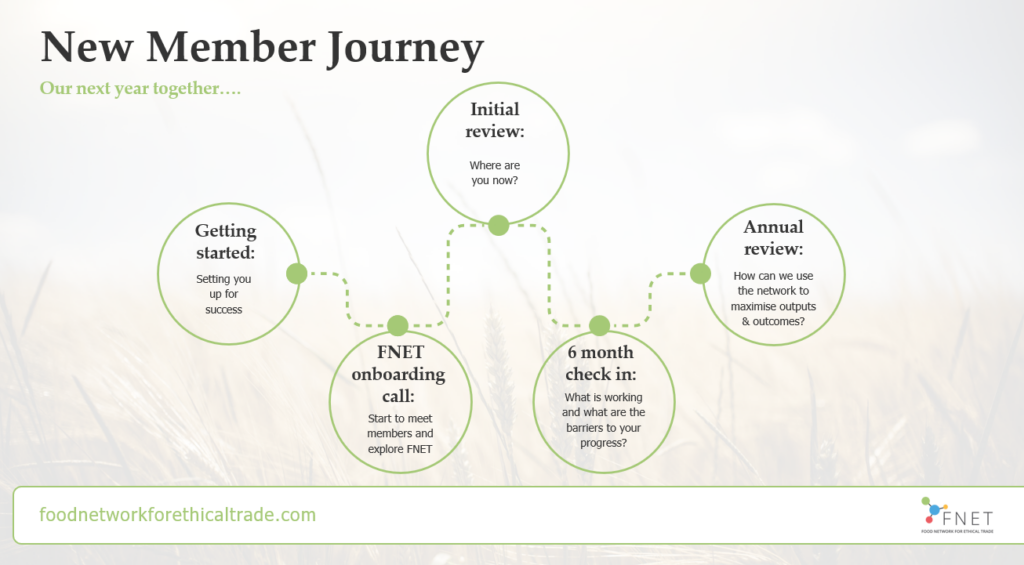
FNET’s human rights due diligence framework is just one of the many tools that members gain access to when they join the network. During their first year, new members receive a tailored review of their HRDD framework and recommendations for improvements from our technical team. Members can also access the full Risk Assessment tool, subject specific tools and resources, such as a recently developed “spot the risks of heat stress” tool and much more. Find out more about joining FNET.