
Our Impact
FNET strives to achieve improved livelihoods and working conditions of people within, and communities affected by, the operations and supply chains of member organisations.
FNET's 10th anniversary
The team at FNET are excited to share the 10 year anniversary report, sharing highlights and insights of the network from 2016-2026.
The report includes an introduction from our Executive Director, Louise Nicholls, a timeline of FNET’s activities over the past decade, stories of impact, practical learnings and a look ahead with the Board Chair, Pins Brown.
Theory of Change.
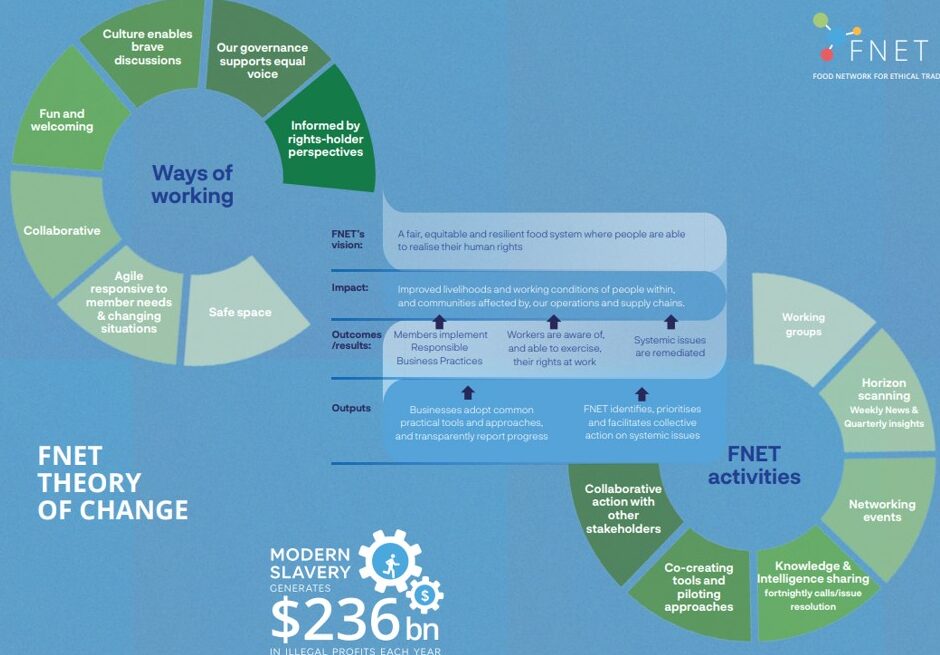
FNET’s work is guided by a three-year strategy and Theory of Change. The Theory of Change was developed in 2024 in a consultative process with members, the board and the technical team.
The Theory of Change underpins FNET’s five core workstreams, priorities and ways of working. It highlights three core outcomes of FNET’s collaborative work.
Our members share their insights on 10 years of the Food Network for Ethical Trade
Our stories
FNET creates a safe and collaborative space for food companies across the supply chain to share and learn from each other in order to improve human rights for workers in their operations and supply chains.
Fiona Wheatley
Former Responsible Sourcing Manager at Bakkavor
“FNET’s membership network and resources enabled me to learn quickly, grow professionally, and develop plans to strengthen our business’s contribution to human rights protections across our supply chain. I’m profoundly grateful to FNET for providing not only excellent technical guidance but also fostering incredible relationships and a lifelong network of committed experts.”
Courtenay Forbes
Human Rights Manager
“Responsible recruitment can be a daunting topic for practitioners navigating complex recruitment pathways in high-risk geographies, and there are strong and differing opinions on the best approach. In light of all these challenges, I am proud that the FNET working group has, and continues to, serve as a safe space to explore ideas, challenge one another positively and find areas of alignment to move members that one step forward.” [Taken from FNET’s anniversary report]
Andy York
Social Sustainability Manager
“I’m very proud of the way we responded in the COVID-19 pandemic, where we gave free guidance out to as many people as possible. It really showed the industry coming together and working together to try and crack issues.”
Mel Miles
Head of CSR - Europe
“Imagine it more as a kind of test laboratory, a live test laboratory for human rights approaches. It’s a very creative space. Approaches are being tried, challenged, stress-tested, worked with, discarded or improved, live. I genuinely struggle to articulate the huge difference it’s made to my work.”