

With increasing regulatory, ESG, and supply chain pressures, companies are expected to engage stakeholders in more structured, inclusive, and impactful ways. To support this, the Food Network for Ethical Trade is proud to co-launch guidance on Meaningful Stakeholder Engagement for the agrifood sector. This practical guidance was primarily written by Oxfam, and co-developed and co-financed by AIM-Progress, amfori, Ethical Trading Initiative, Ethical Trade Sweden, Fair Labor Association, and the Food Network for Ethical Trade.
The guidance includes practical tools, indicators and case studies to help companies drive meaningful outcomes over time. It also helps companies to understand whether their engagement is effective. The guidance includes practical support on embedding engagement across functions and securing internal buy-in. It also provides tools for identifying core stakeholders and measuring the impact and effectiveness of the engagement.
What is Meaningful Stakeholder Engagement?
Meaningful Stakeholder Engagement (MSE) is the process of engaging stakeholders in a safe, respectful, and ongoing dialogue. It ensures their perspectives can inform company decisions. And in turn, contribute to improved human rights and environmental outcomes.
Companies are increasingly expected to engage meaningfully with stakeholders. This is in line with legal requirements and “best-practice” expectations on human rights and environmental due diligence. This guidance has been written to help companies reflect on their due diligence and assess how engagement can be made more impactful and effective. It aligns with international standards, including the OECD Guidelines for Responsible Business Conduct.
In order to be truly meaningful, there must be a commitment to engage in good faith and to resource the approach adequately. Stakeholders must be informed, able to participate safely, and to inform decisions. It also requires ongoing dialogue and a clear link between stakeholder input and company action. This guidance supports businesses in breaking down the steps required to make the work practical, actionable and meaningful.
What are the key principles of effective stakeholder engagement?
The guidance outlines core principles to guide businesses on conducting Meaningful Stakeholder Engagement. See a snapshot here:
- Engagement should be early and continuous
- The approach must be rights-based, with stakeholders well informed
- Participation must be made safe and accessible
- Companies must enter into this in good faith. They must seek effective ways to engage meaningfully and to make the process inclusive and legitimate
This is a simple snapshot; the guidance contains a practical tool outlining the core principles. Find out more below.
What are the unique challenges of stakeholder engagement in agriculture and food supply chains?
With nearly 1.3 billion people working in agrifood systems, the sector is the world’s largest employer, and one of its most complex. The food sector is known for long, fragmented, and often opaque supply chains. This can make it difficult for companies to fully understand and address human rights and environmental risks. Concentrated buying power can also shift costs and risks onto suppliers, smallholders, and workers.
Meaningful Stakeholder Engagement is a practical and powerful way for companies to improve their understanding of the realities in their supply chains. It can support them to uncover hidden risks, and strengthen their due diligence. This guidance has been developed specifically to support agriculture and food manufacturing companies as they explore Meaningful Stakeholder Engagement.
How does stakeholder engagement support ESG and sustainability goals?
Stakeholder engagement plays a critical role in due diligence in multiple ways. For example:
- It generates insights from affected stakeholders
- It informs risk identification and decision-making
- It supports more effective and inclusive interventions
Stakeholder engagement is increasingly recognised as a core component of responsible sourcing and supply chain transparency. Particularly as new sustainability laws prioritise Meaningful Stakeholder Engagement.
In the EU, the Corporate Sustainability Reporting Directive (CSRD) and the Corporate Sustainability Due Diligence Directive (CSDDD), both outline requirements on Meaningful Stakeholder Engagement. Both laws require companies to demonstrate structured, ongoing engagement with affected stakeholders. This should form part of their diligence, risk management and reporting obligations.
This guidance has been developed to directly support the food and agriculture sector as companies look to embed this approach.
How can companies implement Meaningful Stakeholder Engagement in practice?
This guidance supports companies to get started with Meaningful Stakeholder Engagement in agriculture and food supply chains. It outlines a practical approach that focuses on who to engage, how to engage, and when to engage.
Here are some tips for getting started:
- Identify and prioritise stakeholders
Start by mapping stakeholders across your supply chain, with a focus on affected groups such as workers, smallholder farmers, and local communities. Prioritise those most at risk or least heard, including women and migrant workers. - Ensure engagement is inclusive and safe
Engagement should be rights-based, with stakeholders informed, able to participate, and protected from harm. Address power imbalances and create conditions where people can speak openly. - Use appropriate methods and build trust
Tailor engagement methods to different groups, and work with trade unions or local partners where needed. Consistent and respectful dialogue is key to building trust over time. - Engage early and continuously
Start engagement early and maintain it throughout the due diligence cycle to identify risks and improve outcomes over time. - Track effectiveness and learn from findings
Use the guidance’s impact metrics indicators to assess whether engagement is influencing decisions and delivering better outcomes.
What’s in this guidance?
Here is a simple overview of what is included in the main guidance:
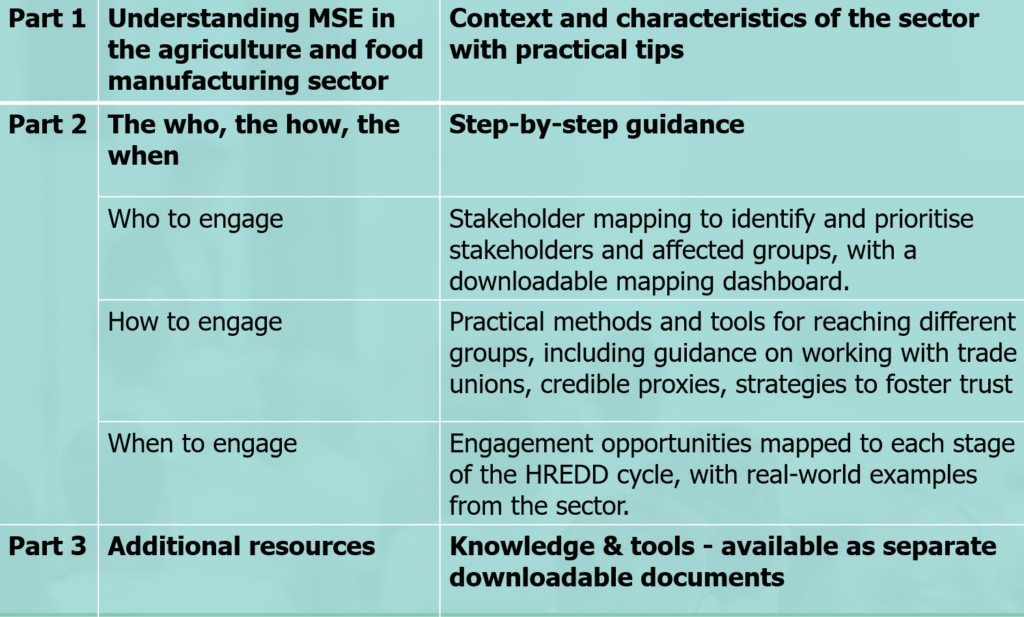
There is also a stand-alone annex with additional resources. It includes:
- A knowledge tool with:
- A Q&A on Meaningful Stakeholder Engagement
- A list of potential engagement tools, with benefits and limitations
- Different forms of trade unions and worker representation, and what they mean for MSE
- Practical tools, including:
- Guiding questions for meaningful stakeholder engagement (MSE) principles (“what good looks like”)
- Stakeholder mapping tool for MSE in the agriculture and food manufacturing sector
- Data collection and management tool for MSE in the agriculture and food manufacturing sector
Meaningful Stakeholder Engagement is a critical part of effective due diligence and sustainable business in agriculture and food supply chains. This guidance provides a practical starting point for companies looking to strengthen their approach and deliver better outcomes for workers, communities, and the environment.
We want to say a huge thank you to Oxfam, AIM-Progress, amfori, Ethical Trading Initiative, Ethical Trade Sweden and Fair Labor Association for their collaborative work on this project.
Download the full guidance to start embedding meaningful stakeholder engagement in your organisation. Also avaialble in Spanish. And if you’re just after a snapshot, download a handy two-page summary of the guidance.
