
As the Food Network for Ethical Trade kicks off its new financial year, we are thrilled to share some of our priorities for the coming year. As many of our members, allies and partners know, FNET turns 10 this year. And we will be celebrating in style! But this is just one of the many things we will be focusing on over the coming year.
The newly agreed workplan involves activities across six working groups and the organisation as a whole. This workplan is designed around our Theory of Change. It aims to improve the livelihoods and working conditions of people affected by the supply chains and operations of member companies.
We want to thank the working group leads, the Board and our members for helping to design this workplan. The plan has been designed to support our members with:
- technical support to understand and address human rights risks,
- stronger practical tools to drive action,
- opportunities to learn from each other,
- and collaborative ways to solve challenges as we drive responsible business practices.
Celebrating 10 years of the Food Network for Ethical Trade
We almost cannot believe it’s been 10 years since the first iteration of the Food Network for Ethical Trade began. FNET was established to heighten collaboration, collective problem-solving, and enhance transparency. And over the past 10 years, it has grown from strength to strength. At its inception in 2016, FNET comprised five retailers and 35 suppliers. Members worked together to develop a risk assessment tool, upskill on ethical trade risks in supply chains and to collaborate. As we embark on the 10th anniversary, FNET now has over 80 members across a diverse range of companies. We are excited to celebrate this milestone at our next all-member meeting in May.
Interested in knowing more about FNET all-member meetings? See this blog from our biggest ever all-member meeting last Autumn.
Strengthening human rights work across our membership
FNET continues to support companies to improve the outcomes for workers in their operations and supply chains. The network is diverse and collaborative. FNET’s team works across six working groups, provides weekly news emails, and fortnightly calls for members. These activities support members to keep on top of new research and practice and relevant food and human rights news.
FNET prioritises listening to members’ needs and responding with solutions where possible. That’s why we’ve decided to launch a new Working Group on Responsible Procurement.
Launching the Responsible Procurement Working Group
This new Working Group, facilitated for FNET by Inherently Human, will focus on practical guidance on responsible procurement principles. It will also support cross-functional learning between buyers and sustainability professionals. And, like all FNET working groups, it will develop and pilot new tools and resources for members and invite guest speakers.
Raw Materials Working Group
Throughout 2026-27, the Raw Materials Working Group will continue to focus on specific raw materials. It will invite guest speakers to share insights in member webinars on particular commodities, such as sugar, soy, palm oil and cocoa. Members will be invited to share human rights impact assessments on core topics. Sharing in this way supports members to learn from each other as much as possible and to prevent duplication.
Climate Change and Human Rights Working Group
This Working Group continues to focus on the points of connection between climate change and human rights. The Group supports members to tackle these important issues collaboratively within their companies. In 26-27, the Group will focus on:
- heat stress and worker health,
- water security,
- biodiversity, deforestation and land management,
- human rights and environmental due diligence.
It will also continue to discuss company action towards just transitions across the food sector.
Developing Common Due Diligence Tools Working Group
The Common Due Diligence Tools Working Group has an ambitious plan for the year. It will develop, trial and pilot practical tools for use across the FNET membership and beyond. The Group is working collaboratively on ethical checklists for supplier visits. It is also exploring updates to FNET’s member-only Risk Assessment Tool (see a sample of the tool), trialling initiatives on remedy, and more!
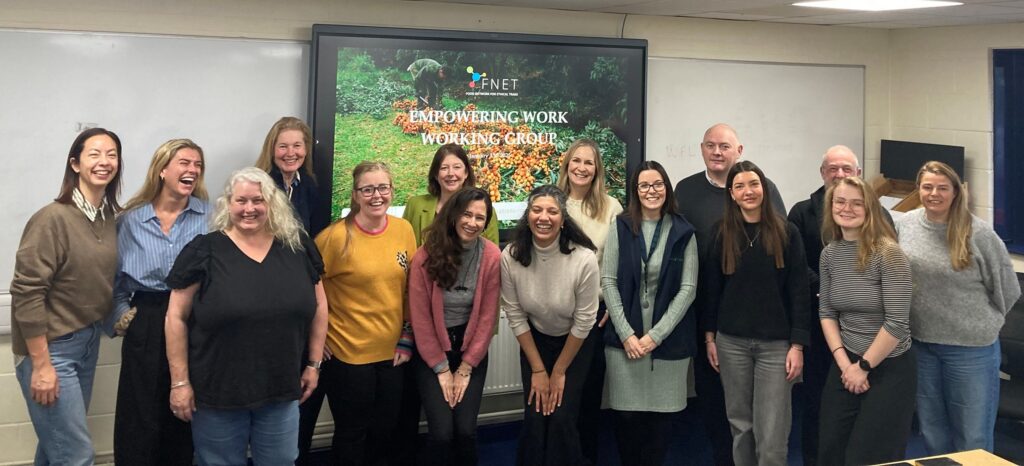
Empowering Work Working Group
This Working Group will continue to embed the FNET Skills Matrix and support companies to identify training gaps. Members will share approaches to living wage commitments and improving worker awareness of rights. The Group will support members with gender-sensitive strategies and support HR teams on SMETA 7.0 compliance.
Responsible Recruitment Working Group
This Working Group has recently welcomed three new Working Group leads. This year, the Group will focus on due diligence of labour providers and engaging workers on responsible recruitment. It will also explore the links with responsible recruitment and modern slavery. And it will look at responsible and fair recruitment across the whole supply chain. The Group will continue to trial practical tools designed within the Working Group and continues to seek member engagement on making these as practical and effective as possible.
Welcoming new members and supporting their onboarding journey
The Food Network for Ethical Trade continues to grow, and we love to welcome new members into our collaborative network. FNET supports new members with an onboarding journey. This journey includes tailored support with developing an action plan on human rights due diligence. If you’re reading this and you’re not yet a member but you’re interested in finding out more, please take a look at our Join page, and get in touch with the team.
The FNET team would be happy to organise a call to share more information and answer any questions.
Moving forward with collaboration and new initiatives
At FNET, we prioritise working collaboratively with partners and other stakeholders. We focus on reducing duplication across the sector. And this often means working closely with other multi-stakeholder initiatives to make sure that we are developing meaningful resources where gaps are identified. We continue to explore efficiencies and formalise partnerships with those we work closely with. Over the coming year, we are taking part in lots of exciting initiatives and working collaboratively with partners on guidance tools (for both members and the public).
What this means for members moving forward
As we reflect on 10 years of FNET, our commitment to creating a fairer and more equitable food system remains the bedrock of our network. The priorities we have outlined in this workplan demonstrate the collective ambition of our members. We know how much stronger our network is for being able to work collectively and collaboratively on issues. By working together, we aim to drive real and lasting change for workers in supply chains all around the world.